

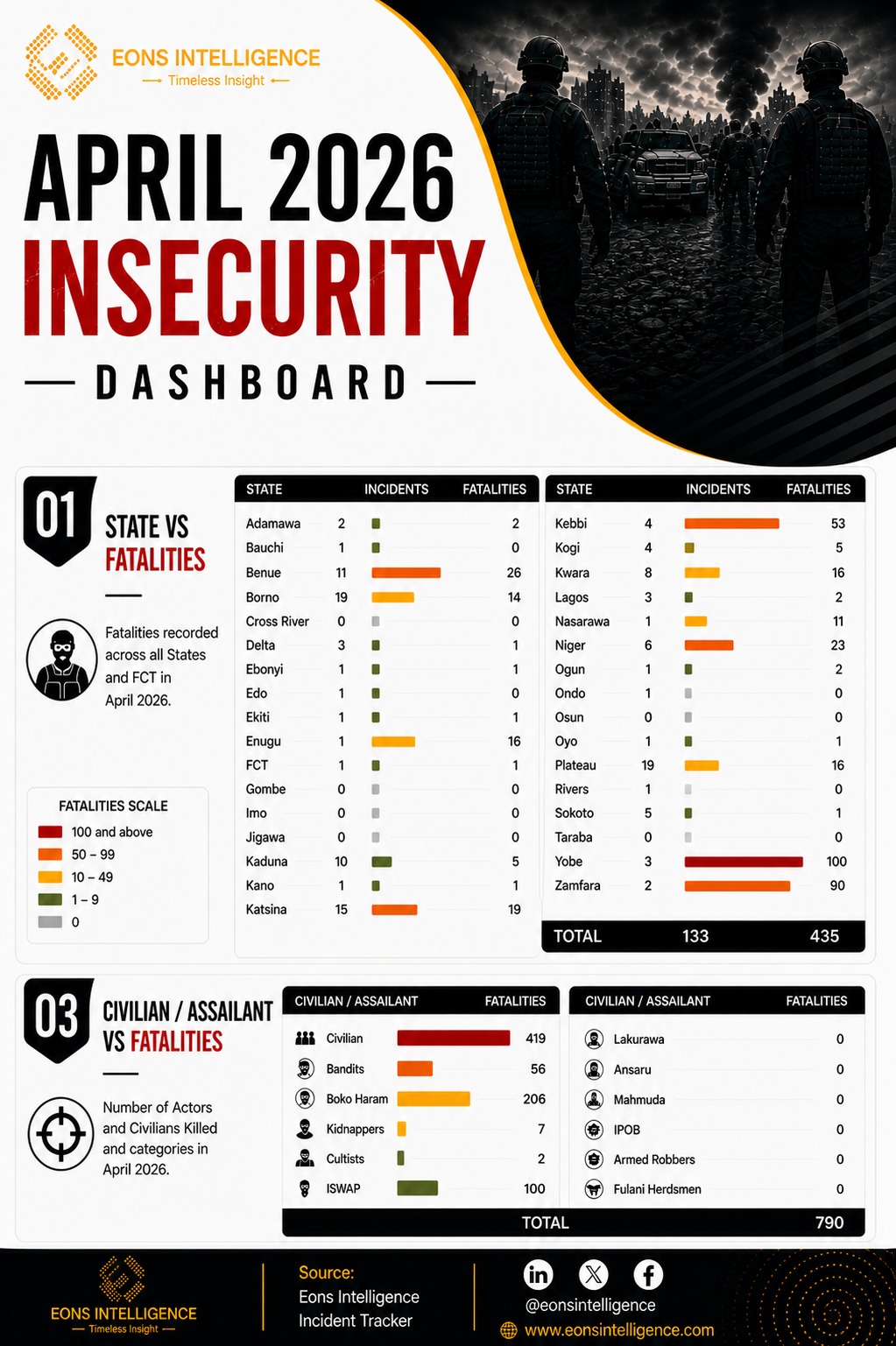
133 Incidents, 435 Fatalities: Airstrike Error, Banditry, and Insurgency Push Nigeria to a Security Breaking Point– Editorial Analysis, EONS Intelligence Security Report, April 2026
Nigeria’s security landscape in April 2026 reveals a nation under extreme pressure, as violence intensified in both scale and consequence across multiple regions. According to the latest EONS Intelligence data, the country recorded 133 incidents and a staggering 435 fatalities, marking one of the deadliest periods in recent months.
At the centre of this crisis lies a disturbing convergence of military operations, insurgent offensives, banditry, communal violence, and systemic security lapses, all contributing to a fragile and increasingly volatile national environment.
The Deadliest Month: When One Error Overshadowed All Violence;
While banditry remained widespread, the most shocking statistic of April was the 100 fatalities caused by military airstrike on the Jilli market along the Borno–Yobe border.
This incident alone accounts for nearly 30% of all recorded deaths, making it the single most lethal event of the month. Though described as a precision strike targeting an insurgent logistics hub, the scale of civilian casualties exposes critical failures in intelligence, targeting, and civilian protection mechanisms.
This tragedy not only redefines the cost of military engagement but also raises serious concerns about operational accountability and the long-term impact on civilian trust.
North East: Highest Death Toll Amid Intensified Warfare
The North East recorded 214 fatalities from 25 incidents, making it the deadliest geopolitical zone despite having fewer attacks than other regions.
This high lethality was driven by:
1. The Jilli market airstrike disaster
2. Sustained clashes with ISWAP and Boko Haram
3. Coordinated attacks on military formations
The killing of senior officers, including a Brigadier-General and a Colonel, highlights the insurgents’ continued ability to execute high-impact, coordinated assaults. At the same time, the issuance of a 72-hour ultimatum and N5 billion ransom demand for 416 abducted victims in Ngoshe signals a dangerous escalation in both psychological warfare and mass abduction tactics.
Despite strong retaliatory air operations that neutralised insurgents and destroyed logistics hubs in Sambisa Forest, Mandara Mountains, and Kukawa, the region remains locked in a cycle of military gains versus civilian vulnerability.
North West: Banditry Evolves into Strategic Violence;
The North West recorded 56 incidents and 167 fatalities, maintaining its position as one of Nigeria’s most volatile regions.
Military successes under Operation FANSAN YAMMA, including the elimination of 50 bandits linked to Ado Aliero, were met with adaptive responses from criminal networks.
Key emerging patterns include:
1. Shift from territorial control to fluid, high-impact attacks
2. Rise in family-targeted kidnappings (e.g., multiple sibling abductions in Kaduna)
3. Attacks on healthcare workers and police facilities
4. Expansion of extremist elements, including the Lakurawa group in Kebbi, linked to a massacre of 44 people
The growing use of motorcycles and forest hideouts continues to limit sustained military control, while the targeting of essential workers threatens long-term governance and service delivery in rural communities.
North Central: Nigeria’s Most Active Conflict Zone
With 50 incidents and 108 fatalities, the North Central region recorded the highest frequency of unrest in April.
The region’s instability is driven by a complex mix of:
1. Communal and sectarian clashes (e.g., violence in Plateau and Nasarawa)
2. Banditry and highway ambushes (notably in Kwara and Niger)
3. Farmer-herder conflicts (particularly in Benue, with 36 fatalities)
Notable incidents include:
Killing of 17 persons in Mbalom (Benue) and additional deaths in Apa and Agatu.
20 fatalities in Shiroro (Niger) after explosives destroyed homes.
Ambush in Patigi (Kwara) killing soldiers and civilians.
Arrest of a serving police officer linked to armed robbery, highlighting internal security breaches.
These developments reinforce the region’s position as a convergence zone for multiple forms of violence, where criminality, insurgency, and communal tensions intersect.
Southern Nigeria: Lower Fatalities, Rising Complexity
Although the southern regions recorded fewer deaths, the threat landscape is becoming more sophisticated and unpredictable.
South South (7 incidents, 2 fatalities)
Maritime piracy persists (e.g., 14 victims rescued in Akwa Ibom).
Deadly highway ambushes along Benin–Ore corridor.
Rising concern over extrajudicial killings, particularly in Delta.
South West (7 incidents, 6 fatalities);
Cult violence in Lagos (Buccaneer vs Eiye clashes);
High-value residential kidnappings (N60 million ransom case).
Attack on religious institutions, including the killing of a pastor in Ekiti.
Farmer killings and agrarian tensions in Oyo.
South East (2 incidents, 1 fatality);
Continued assassination of traditional rulers in Ebonyi.
Use of improvised explosive devices (IEDs) in Anambra.
Despite low fatality figures, these regions are witnessing a shift toward targeted, high-value, and psychologically disruptive attacks.
State-Level Hotspots: Where the Impact Was Most Severe
Several states recorded notably high fatalities:
Yobe: 100 deaths (linked to airstrike incident)
Zamfara: 90 deaths
Kebbi: 53 deaths
Benue: 36 deaths
Niger: 23 deaths
Katsina: 19 deaths
Plateau: 16 deaths
Kwara: 16 deaths
These figures highlight a concentration of violence in northern and middle-belt states, reinforcing the regional imbalance in security outcomes.
Breakdown of Violence: Banditry Still Dominates.
A categorical analysis shows that:
Banditry: 112 fatalities (most widespread threat).
Military Airstrike: 100 fatalities (deadliest single cause).
Kidnapping: 34 fatalities
Fulani herdsmen violence: 23 fatalities
Terrorist attacks: 12 fatalities
Communal clashes: 20 fatalities
Mob violence: 7 fatalities
Cattle rustling: 7 fatalities
Force misconduct: 4 fatalities
Police ambush: 2 fatalities
Inter-bandit clashes: 1 fatality
This distribution underscores a critical reality: while banditry drives frequency, isolated high-impact events now determine overall lethality.
Security Forces: Mounting Losses and Vulnerabilities
Security personnel also paid a heavy price:
Vigilantes: 11 fatalities
Soldiers: 8 fatalities
Policemen: 2 fatalities
The higher death toll among vigilantes reflects their exposure as frontline community defenders, often operating with limited protection.
Editorial Perspective: A System Under Strain.
April’s data reveals a troubling contradiction—while the Nigerian military continues to record tactical victories, the overall security environment is deteriorating.
The reliance on high-intensity kinetic operations, particularly airstrikes, has produced measurable gains against insurgents but also devastating unintended consequences.
At the same time:
Bandits are becoming more adaptive and decentralised.
Kidnappers are targeting higher-value victims.
Communal conflicts are intensifying due to seasonal pressures
Public trust is eroding due to civilian casualties and misconduct allegations.
Looking Ahead: A Dangerous Transition Period
As Nigeria approaches June 2026, several risks are projected:
Farming season conflicts leading to increased farmer-herder clashes.
Emergence of “harvest taxation” by bandits.
Expansion of urban-to-rural kidnapping operations.
Increased maritime piracy and high-value abductions in the South.
Reduced community cooperation due to airstrike-related civilian casualties.
Without a shift toward intelligence-driven, civilian-focused security strategies, the country risks a deeper crisis where non-state actors begin to fill governance gaps in vulnerable regions.
Conclusion
April 2026 stands as a defining moment in Nigeria’s security trajectory. With 498 lives lost in just one month, including 200 from a single operational failure, the urgency for reform is undeniable.
Nigeria is no longer just fighting insurgents and criminals—it is confronting the consequences of a security system under immense strain, where both action and inaction carry devastating costs.
The path forward demands not just force, but precision, accountability, and protection of civilian life as the central pillar of national security.



Comments