

176 Incidents, 383 Dead, 229 Kidnapped: Nigeria’s Security Crisis Deepens as Terror, Banditry, and Kidnapping Surge — Editorial Analysis, EONS Intelligence Security Report, March 2026
Nigeria’s security situation in March 2026 presents a grim and deeply fragmented reality, as fresh data from EONS Intelligence reveals a nation battling a multi-front crisis where violence is intensifying both in scale and sophistication.
With 176 security incidents and 383 fatalities recorded nationwide, alongside 55 kidnapping incidents involving 229 victims, the report exposes a country where the lines between insurgency, banditry, and organised crime are increasingly blurred, and where civilian populations remain the primary victims.
A Multi-Front War: Crime and Insurgency Converge
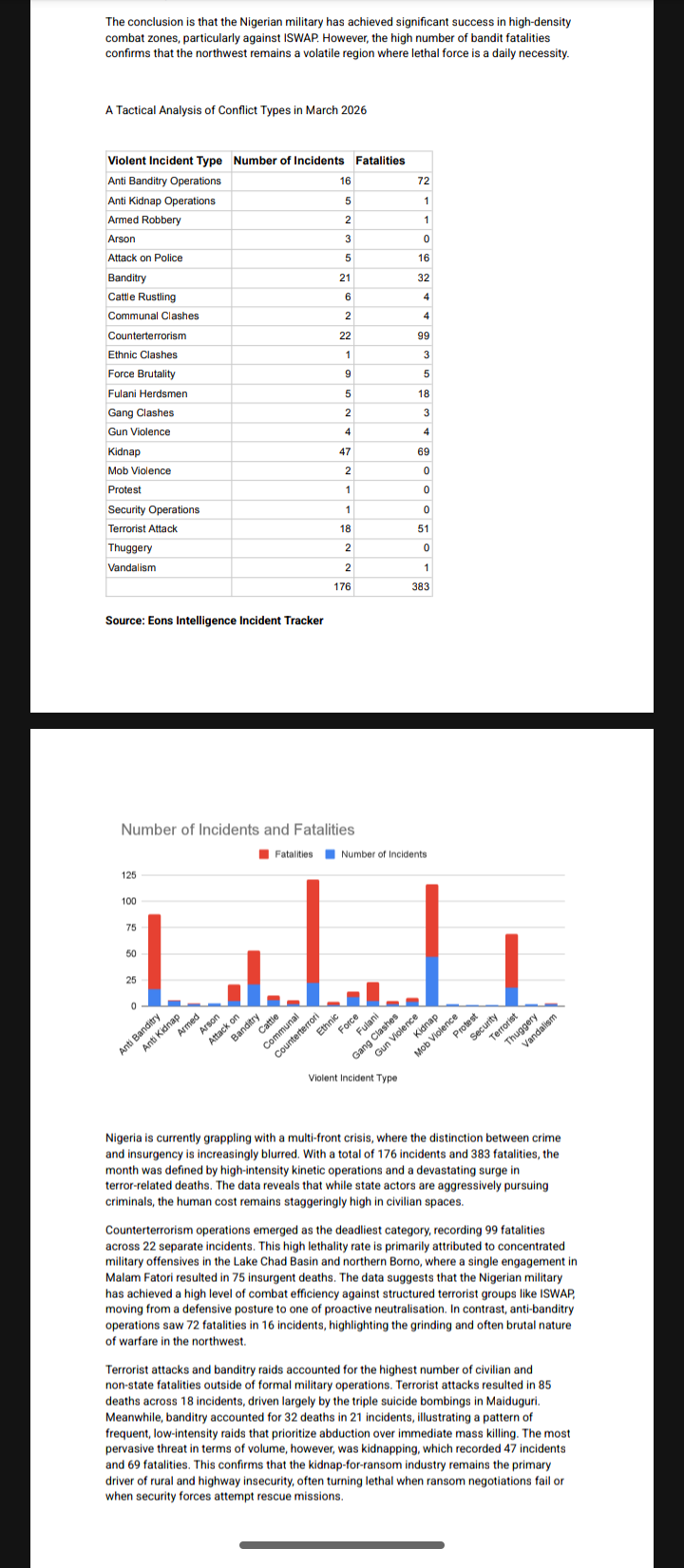
The March data confirms that Nigeria is no longer facing isolated security challenges, but rather a converging conflict system. A total of 176 violent conflict-related incidents led to 383 fatalities, reflecting the deadly nature of both state-led operations and non-state attacks.
At the center of this violence are counterterrorism operations, which emerged as the deadliest category, accounting for:
22 incidents
99 fatalities
This high death toll is largely attributed to concentrated military offensives in northern Borno, particularly the Malam Fatori operation, where dozens of insurgents were neutralised in a single engagement. While this reflects growing military efficiency, it also underscores the intensity of ongoing combat.
Closely following are anti-banditry operations, which recorded:
16 incidents
72 fatalities
These figures highlight the sustained and often brutal engagements between security forces and bandit groups, particularly in the North-West.
Terror, Banditry and Kidnapping: The Civilian Toll
Beyond military operations, the civilian population continues to bear the heaviest burden.
Terrorist attacks: 18 incidents, 85 fatalities
Banditry: 21 incidents, 32 fatalities
Kidnapping: 47 incidents, 69 fatalities.
The data reveals that while terrorist attacks produce high-impact, mass-casualty events, banditry operates through frequent, low-intensity raids, often designed to abduct rather than kill.
However, kidnapping stands out as the most pervasive and economically driven threat, reinforcing its status as Nigeria’s dominant security challenge.
Other notable categories include:
Attack on police: 6 fatalities
Fulani herdsmen-related violence: 5 incidents, 18 fatalities
Cattle rustling: 6 incidents, 4 fatalities
Communal clashes: 2 incidents, 4 fatalities
Ethnic clashes: 1 incident, 3 fatalities
Gun violence: 4 incidents, 4 fatalities
Force brutality: 9 incidents, 5 fatalities
Lower-impact incidents such as arson (3 incidents, 0 fatalities), protests (1, 0), mob violence (2, 0), thuggery (2, 0), and vandalism (2, 1) reflect ongoing instability but with comparatively limited lethality.
Kidnapping Economy Expands: 229 Victims in One Month
The kidnapping data paints one of the most disturbing pictures of Nigeria’s current security reality.
In March alone:
55 kidnapping incidents
229 victims abducted
The geographical spread highlights both scale and specialization:
Zamfara: 16 incidents, 30 victims (highest frequency)
Katsina: 7 incidents, 37 victims
Kaduna: 5 incidents, 15 victims
Kwara: 5 incidents, 13 victims
Kogi: 5 incidents, 4 victims
Borno: 3 incidents, 100 victims (highest single-state toll).
The Borno figure is particularly alarming, driven by a mass abduction from an IDP camp, demonstrating how insurgents continue to deploy kidnapping as a tool of terror, recruitment, and control.
Other affected areas include:
FCT: 1 incident, 6 victims
Ondo: 1 incident, 3 victims
Oyo: 1 incident, 4 victims
Enugu: 1 incident, 2 victims
Ebonyi: 1 incident, 1 victim
Benue & Plateau: 1 victim each.
Notably, several southern states such as Lagos, Rivers, Ogun, and Ekiti recorded zero cases, though analysts warn this may reflect underreporting rather than complete absence.
Regional Divide: A Nation Split by Violence
The data reinforces a stark geographical imbalance in security outcomes.
North-West: Highest volume of incidents and fatalities
North-East: Fewer incidents but extremely high lethality
North-Central: A growing mix of terrorism, abductions, and communal violence
Southern regions: Lower fatalities but rising criminal sophistication
This divide confirms that security in Nigeria is increasingly determined by location, with northern regions facing militarised violence, while the south contends with evolving criminal economies.
Security Forces Under Fire
The cost of maintaining security remains high. Security personnel continue to face targeted attacks, particularly:
During anti-banditry and counterterrorism operations
In ambushes on transit routes
While responding to urban terror incidents
The pattern suggests that criminal and insurgent groups are deliberately targeting both state forces and local vigilantes, aiming to weaken frontline resistance and create operational space.
Editorial Perspective: Winning Battles, Losing Protection
While the data shows that Nigerian security forces are achieving measurable success in neutralising insurgents and bandits, a critical gap remains—civilian protection.
The current strategy appears heavily focused on attrition-based warfare, where enemy combatants are eliminated. However, the continued rise in:
Kidnapping
Civilian fatalities
Soft-target attacks
suggests that criminal groups still retain the initiative, particularly in choosing when and where to strike.
The Road Ahead: A Critical Turning Point
Looking forward, the report warns of escalating risks tied to economic and seasonal activities:
Farming season may trigger “farming taxes” and rural abductions
Major highways may see increased ambushes during peak travel periods.
Urban centers could face renewed IED attacks and coordinated strikes.
Southern regions may experience more targeted urban kidnappings.
Conclusion
The March 2026 EONS Intelligence Report delivers a clear and urgent message: Nigeria’s security crisis is not only deepening but evolving faster than current containment strategies.
With 383 lives lost and 229 people abducted in a single month, the need for a shift from reactive military responses to proactive, intelligence-driven civilian protection has never been more critical.
Until such a transition occurs, the country risks entrenching a dangerous reality—one where violence is normalised, and safety becomes a privilege defined by geography rather than governance.



Comments